
More Indians start car shopping online, pushing automakers and dealers to respond quickly, train staff, and use AI to turn clicks into showroom visits.

Vinfast sold 137 cars versus Tesla's 109 during the festive months of September and October, as BYD maintained a strong lead with over 1,100 cars sold, according to Fada data.

Major automakers, including Maruti Suzuki, Hyundai, Tata Motors, Mahindra & Mahindra, Kia, Toyota and Honda, on Thursday reported healthy growth in passenger vehicles sales in June, recovering from the disruptions induced by the second wave of COVID-19. The country's largest carmaker Maruti Suzuki India (MSI) posted total sales of 1,47,368 units in June, up from 46,555 units in May. Its domestic dispatches to dealers last month stood at 130,348 units, up from 35,293 units in May, as easing of COVID-related restrictions helped the auto major to dispatch more units to dealerships.
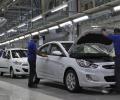
Automakers Maruti Suzuki, Tata Motors, Mahindra & Mahindra and Kia reported robust growth in their vehicle dispatches in the domestic market for August buoyed by festive demand and easing of semiconductor shortage woes. Other manufacturers like Hyundai, Toyota and Skoda also reported growth in wholesales in August as compared with the same month last year. The country's largest automaker Maruti Suzuki India said its domestic passenger vehicle dispatches increased by 30 per cent to 134,166 units in August as compared with 103,187 units in the year-ago month.

Stock market sentiment is likely to remain optimistic going ahead, though some consolidation cannot be ruled out after the recent sharp rally in the benchmarks, analysts said. According to experts, the Nifty and Sensex could indeed move towards new record highs before the end of the year, if global cues stay supportive, crude oil prices remain benign and there is continued domestic earnings momentum.

The government plans to establish a fully indigenous manufacturing ecosystem with an annual production capacity of up to 6,000 tonnes. The scheme is expected to run for seven years, according to official documents.

Among Sensex firms, Mahindra & Mahindra was the biggest gainer, gaining 1.7 per cent after the October sales data. Tata Motors Passenger Vehicles (TMPV) rose by 1.69 per cent. Eternal, State Bank of India, Bharti Airtel and Kotak Mahindra Bank were also among the major gainers.

Manufacturers of passenger vehicles (PVs) in the first half of the calendar year (2025) reported a modest 0.5 per cent year-on-year increase in wholesale dispatches, while retail sales grew 2.5 per cent for the same period, reflecting a calibrated approach by automakers amid elevated dealership inventories and cautious consumer sentiment. According to the Society of Indian Automobile Manufacturers (Siam), dispatches rose marginally to 2.16 million units, up from 2.15 million units a year earlier.

Fada estimates that global supply chain headwinds like scarce availability of rare earth elements for electric vehicle components and geopolitical tensions may affect urban consumer sentiment in June as well.

Before signing up for a BNPL plan, read the fine print carefully and watch for red flags like unclear repayment terms, vague information on interest or late fees, and marketing that downplays the cost of default.
BS-VI emission norms and the COVID-19 lockdown impacted the dispatches.

The growing impact of inflation on car sales is clearly reflected in the dismal growth in domestic sales of the country's three leading auto-makers - Maruti Suzuki, Hyundai India and Tata Motors - which constitute more than 75 per cent of the car sales.

Automobile sector saw a huge spurt in sales in September as per figures that poured in on Friday.
Major automobile manufacturers like Maruti Suzuki, Hyundai, Mahindra & Mahindra, Tata Motors and Toyota Kirloskar on Tuesday reported decline in domestic passenger vehicle sales in May compared to the previous month as a spike in COVID-19 cases and lockdowns across various states hit production and dispatches. The country's largest carmaker Maruti Suzuki India (MSI), which shut production from May 1 to May 16 so as to divert oxygen from industrial use for medical purposes, reported domestic dispatches to dealers at 35,293 units last month, down 75 per cent from 142,454 units in April. The company said sales of its mini cars, comprising Alto and S-Presso, declined by 81 per cent to 4,760 units in May as against 25,041 units in April this year.

Companies with "gas guzzlers" are trying to set up the wrong narrative against small cars getting relaxation in the proposed corporate average fuel efficiency (CAFE-III) norms on the basis of weight, Maruti Suzuki senior executive officer corporate affairs Rahul Bharti said on Monday, bringing to the fore deep division among carmakers regarding the upcoming rules.

Automobile retail sales in India rose around 5 per cent year-on-year in June with all vehicle segments, including passenger vehicles and two-wheelers, witnessing growth, Federation of Automotive Dealers Associations (FADA) said on Monday.

The auto major is not just looking at domestic sales, but also planning to ramp up exports to key markets from here, like the Middle East, North Africa and Australia.
Automobile companies put in an impressive show in April.

Festive buying spree unleashed by lower tax rates pushed gross GST collection to about Rs 1.96 lakh crore in October, registering a 4.6 per cent year-on-year growth -- the slowest rate so far this fiscal.
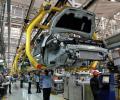
Auto parts exports from India may see a slight slowdown as US President Donald Trump's 25 per cent tariff could increase car prices for buyers by 8-25 per cent, thereby affecting demand, experts believe.

Leading carmakers Maruti Suzuki and Hyundai witnessed a double-digit drop in sales in October on account of the global semiconductor shortage impacting production. Kia India, Honda Cars and MG Motor also saw a fall in dispatches last month as compared with October 2020. However, companies like Tata Motors, Mahindra, Nissan and Skoda managed to post positive numbers last month despite the supply chain challenges.
India's real GDP growth in FY26 will slide further to 6.2 per cent in FY26 from 6.5 per cent in FY25, a Japanese brokerage said on Monday. In a research report, Nomura said there is a "divergence" between the growth in GST collections and across other high-frequency growth indicators like auto sales and bank credit growth.

Grant Thornton Bharat's latest survey indicates that hybrids are set to consolidate market share this festive season, bridging the gap between conventional petrol engines and the emerging electric vehicle segment.

Automobile companies saw remarkable growth in sales in June.

The muted expectation of dealers come at a time when vehicle manufacturers such as Maruti Suzuki, Hyundai Motor, Mahindra & Mahindra and others reported a double-digit fall in wholesale dispatches to dealerships in July and August.

'The government is actively engaging with EU to ensure that concerns of Indian companies and hard-to-abate sectors are adequately addressed under CBAM'
A recent Outlook Money report stated that in the first two quarters of the current fiscal year, Indian companies successfully cut down costs. As a result, they managed to grow net profits. This positive change got reflected directly in the automobile sector with most of the auto majors registering positive sales figures in February.

Maruti Suzuki will introduce eight SUVs over the next five years taking its overall model range to 28 as it aims to regain 50 per cent market share in the domestic passenger vehicle segment, Suzuki Motor Corporation Representative Director and President Toshihiro Suzuki said on Wednesday.

Indian passenger vehicles market registered record wholesales of 43 lakh units in 2024, with companies like market leader Maruti Suzuki, Hyundai, Tata Motors, Toyota Kirloskar Motor, and Kia posting their best-ever annual domestic sales. The continued growth of SUVs, along with rural markets playing a key role in driving up car sales, helped the industry better the previous best of nearly 41.1 lakh units posted in 2023.
According to the Society of Indian Automobile Industry, domestic car sales last year fell to 18,07,011 units from 19,98,703 units in the previous year.

For UK automakers, market access to India will be limited by quantity caps and phased tariff cuts, especially on petrol, diesel and electric vehicles.
Car maker Maruti Suzuki India Ltd on Monday reported a 15.75 per cent jump in the total sales in May at 79,872 units as against 69,001 units in the same month last year.

The small sports utility vehicle (SUV) segment - comprising models less than 4 metres in length - could witness the "maximum" growth among all categories in the coming months following the recent goods and services tax (GST) rate rationalisation, Tarun Garg, chief operating officer of Hyundai Motor India (HMIL), said.

Passenger vehicle retail sales witnessed 3 per cent on-year decline in May with customers delaying purchases in several states due to India-Pakistan conflict and further softening of demand for entry-level models, dealers' body FADA said on Friday. The passenger vehicle registrations last month stood at 302,214 units, as compared to 311,908 units in May 2024.
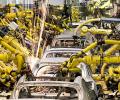
286 dealers closed down in 18 months, 32,000 jobs impacted. Maharashtra leads with 84 closures, followed by Tamil Nadu and Delhi. The worst-hit is the passenger car segment.
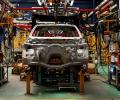
Indian auto component exporters may suffer a hit of 2,700 crore to 4,500 crore on their earnings after the imposition of steep US tariffs on key automotive parts, credit rating agency ICRA said in a note on Monday. The new 25 per cent tariff on engines, transmission, electrical components, and other auto parts may moderate the overall auto component industry's revenue growth to 6-8 per cent in 2025-26 (FY26), down from an earlier projection of 8-10 per cent.
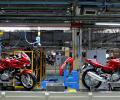
Two-wheeler (2W) giant Bajaj Auto registered record sales across the country over the weekend on the back of Gudi Padwa, hawking 26,938 vehicles that included motorcycles and its electric scooter Chetak.

Bajaj Auto has become the top player in India's electric vehicle market by monthly volumes, across all categories, with over 25,000 sales and registrations in September. This comes on the back of a big push in expanding distribution by the company and steady demand of electric three-wheelers. In September, the company - according to the latest Vahan data - recorded sales of 17,570 electric two-wheelers, 4,575 three-wheelers, and 3,000 Yulu low-speed electric bikes (based on company sales numbers), which do not require a licence and are not registered on Vahan.

'Our vision is to innovate as many products as we can and solve as many problems as possible.'
 © 2026 Rediff.com - Advertise with us - Disclaimer - Privacy Policy - Sitemap - Feedback - About us - Terms of use - Grievances